Quick answer: Full-grain leather retains the outer grain surface with natural pores and markings largely intact. Top-grain is a broader term for leather from the upper hide layer that may be sanded, corrected and refinished for a more uniform appearance.
Hide layers and corrected surfaces
Full-grain leather retains the outer grain surface with natural pores and markings largely intact. Top-grain is a broader term for leather from the upper hide layer that may be sanded, corrected and refinished for a more uniform appearance.
Neither label explains tannage, thickness, clicking quality or shoemaking. A well-selected corrected top-grain upper can outperform poorly processed leather carrying a more prestigious phrase.
Why retail labels can be vague
Product pages often use “genuine,” “premium” or “full-grain” without describing the finish. Those terms may not reveal whether the surface has been heavily corrected, embossed or coated.
Look for precise material language across the listing, packaging and manufacturer site. When descriptions conflict, treat the exact grade as unconfirmed rather than inferring it from price or photographs.
Patina, uniformity and maintenance
Minimally corrected full-grain leather can develop color variation and character as it ages, but it may also show natural marks. Corrected top-grain tends to begin more uniform and can be easier to present consistently.
Maintenance depends heavily on the applied finish. An open, waxy leather accepts conditioner and cream differently from a sealed surface, regardless of the headline grade.
Price does not prove leather grade
Retail price reflects branding, construction, labor, distribution and design as well as upper material. An expensive shoe is not automatically full-grain, and a value shoe is not automatically synthetic.
Verify the exact selected variation because brands sometimes change materials across colors or product families. A broad brand reputation cannot substitute for model-level evidence.
How to inspect product descriptions and images
Search the description for the upper, lining and sole materials separately. Photos can reveal grain variation, coating gloss and panel consistency, but studio lighting may conceal texture.
Zoom in on flex areas and edges while remembering that images cannot prove the hide layer. Use photographs to test whether the written claim looks plausible, not to manufacture a grade the listing never states.
When top-grain is a sensible choice
A uniform corrected surface can suit formal shoes where consistent color and easy presentation matter. It may also resist minor staining better when the finish is appropriately maintained.
Choose the shoe that fits, serves the dress code and has a finish you can care for. Full-grain is not a reason to accept poor fit, weak construction or a style that will rarely be worn.
CURRENT AMAZON OPTIONS
Compare each represented side on Amazon.
As an Amazon Associate, we earn from qualifying purchases. Amazon links open the exact listing so you can confirm current size, color, price, and availability.

Clarks · Dark tan leather
Clarks Tilden Cap Oxford
A classic cap-toe lace-up offered by Amazon in regular and wide sizing.

Cole Haan · Burgundy
Cole Haan Pinch Tassel Loafer
A heritage tassel shape that brings personality to navy, gray, and cream trousers.
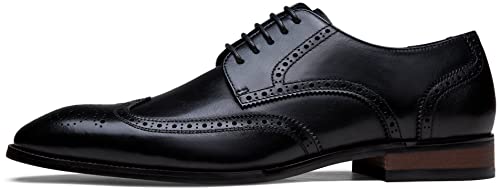
Jousen · Brown
Jousen Men's Full-Grain Leather Wingtip Oxford
Leather wingtip with brogue perforations, leather lining, and blind-eyelet lacing.

Dockers · Black
Dockers Agent Bike-Toe Leather Loafer
Leather bike-toe loafer with flexible construction, cushioning, and a rubber outsole.
QUICK ANSWERS
Questions shoppers ask next.
Is full-grain leather always better?
No. It preserves the natural grain, but durability and appearance also depend on tannage, thickness, hide selection, finishing and shoe construction. Fit and intended use remain essential.
Does top-grain leather peel?
Top-grain leather itself does not automatically peel. Heavy surface coatings can crack or separate, while lightly corrected top-grain may age normally. The finish matters more than the term alone.
What does corrected-grain leather mean?
The natural surface has been sanded or buffed to reduce imperfections, then often embossed and finished for uniformity. Correction ranges from light treatment to a heavily coated appearance.
How can you identify full-grain leather shoes?
Use explicit manufacturer or listing documentation. Natural variation can support the claim but cannot prove it from a photograph; avoid relying on price, smell or texture alone.