Quick answer: Traditionally, a Derby has two separate quarters sewn under the vamp, while a blucher places small lacing tabs on top of a one-piece vamp. Both leave the lacing area open and adjustable.
Historical definitions and modern retailer usage
Traditionally, a Derby has two separate quarters sewn under the vamp, while a blucher places small lacing tabs on top of a one-piece vamp. Both leave the lacing area open and adjustable.
Modern American retailers often use blucher and Derby interchangeably, so a product title may not preserve the historical distinction. Photographs and pattern pieces reveal more than the marketing label.
Quarter construction diagrams in words
Imagine a Derby from above: the vamp covers the front of the foot, and two larger side panels rise toward the tongue carrying the eyelets. Their lower edges are visibly stitched to the vamp.
On a traditional blucher, the front and sides read as one continuous piece, with smaller eyelet tabs attached on top. Both designs open wider than an Oxford because the eyelet sections are not trapped beneath the vamp.
Why both offer lacing adjustment
The open-lacing architecture lets the quarters spread or draw together over the instep. That adjustment can help accommodate higher insteps or changes in sock thickness, although it cannot create additional sole width.
If the eyelet rows flare dramatically when tied, the last may still be too low-volume. If they overlap or close completely while the heel slips, the shoe may have too much internal volume.
Formality and toe-detail variables
A plain-toe black Derby with a slim leather-look sole can be appropriate with many suits. A tan blucher with heavy broguing and a lugged sole belongs much lower on the formality scale despite sharing open lacing.
Judge toe decoration, upper texture, color, welt prominence and sole thickness together. The small historical difference between blucher and Derby matters less to dress code than these visible signals.
High-instep and wide-foot implications
Open lacing generally gives high-instep wearers more room to adjust pressure than closed-laced Oxfords. A generously cut tongue also helps distribute lace tension instead of concentrating it across one point.
Wide feet still require a suitably wide last or an offered width size. Loosening the laces may relieve the instep while leaving the ball of the foot crowded over the sole edge, which is not a true width solution.
How to search Amazon without missing either term
Search both “men's Derby dress shoes” and “men's blucher shoes,” then add the needed feature such as wide, plain toe, leather or rubber sole. Retail listings may use Oxford incorrectly as a general synonym for lace-up dress shoe.
Confirm the construction visually: open quarters should lift away from the vamp when unlaced. Check the selected color and width because Amazon variation families can place materially different options under one page.
CURRENT AMAZON OPTIONS
Compare each represented side on Amazon.
As an Amazon Associate, we earn from qualifying purchases. Amazon links open the exact listing so you can confirm current size, color, price, and availability.
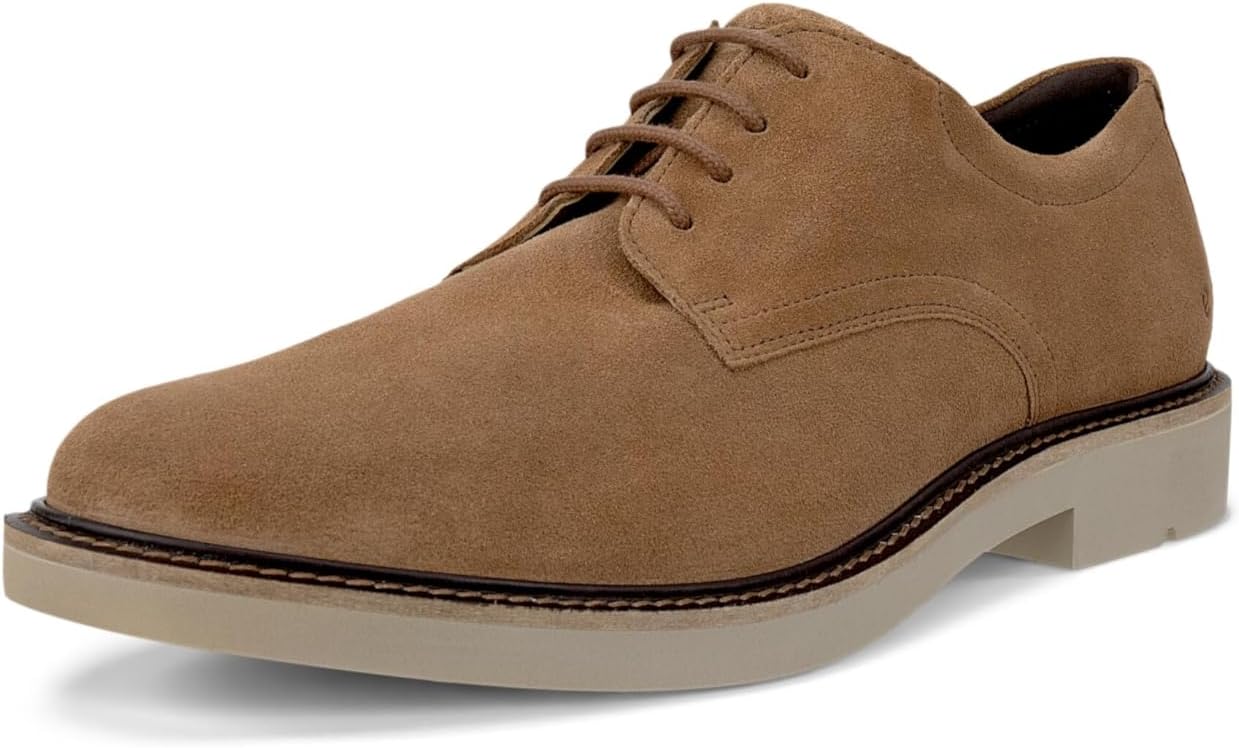
ECCO · Black
ECCO London Plain-Toe Derby
A round-toe derby profile with a removable dual-fit insole on the Amazon listing.

Bruno Marc · Dark Brown
Bruno Marc Urban Suede Oxford
Soft texture lowers the formality while the lace-up shape keeps the outfit intentional.
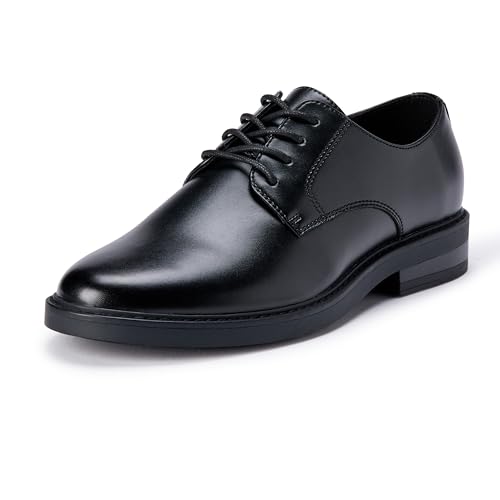
Amazon Essentials · Black
Amazon Essentials Men's Round-Toe Derby Dress Shoes
Open-lacing round-toe derby with an active-response foam cushioned insole.

Amazon Essentials · Black
Amazon Essentials Men's Wingtip Derby Dress Shoes
Classic brogued wingtip derby with cushioning and a rubber sole.
QUICK ANSWERS
Questions shoppers ask next.
Is a blucher the same as a Derby?
They are closely related open-laced shoes and are often treated as the same category. Historically, a Derby uses larger quarters sewn under the vamp, while a blucher uses smaller eyelet tabs attached on top of a one-piece vamp.
Are bluchers less formal than Derbies?
Not inherently. Color, leather finish, toe decoration and sole weight influence formality more than the subtle pattern difference. Either can range from sleek office shoe to rugged casual lace-up.
Can bluchers be worn with suits?
Yes, when the blucher is streamlined, dark, minimally decorated and paired with a suitably formal sole. Chunky, contrast-stitched or heavily brogued versions are better with odd trousers and sport coats.
Are bluchers good for high insteps?
Their open lacing usually offers more instep adjustment than an Oxford. The last still needs enough depth, and excessive eyelet-row flaring is a sign to try a higher-volume model rather than simply loosening the laces.