Quick answer: Standing comfort should be evaluated through heel stability, forefoot room, flex location, outsole grip, and how pressure changes over time. Manufacturer cushioning terms are useful clues but do not prove all-day performance for every foot. The list should be treated as a shortlist for fitting, not a medical promise or universal ranking.
Evaluation criteria and evidence limits
Standing comfort should be evaluated through heel stability, forefoot room, flex location, outsole grip, and how pressure changes over time. Manufacturer cushioning terms are useful clues but do not prove all-day performance for every foot. The list should be treated as a shortlist for fitting, not a medical promise or universal ranking.
Floor type and job pattern matter as much as the shoe. A receptionist standing on carpet needs a different outsole emphasis from a hospitality worker moving across wet tile. Confirm current materials, removable-insole details, widths, and slip claims on the exact Amazon variation before relying on them.
Stable cushioned Oxfords
A comfort-oriented Oxford preserves a closed-lace office silhouette while adding a more forgiving underfoot platform. Models such as the Rockport Margin or similarly restrained lace-ups can suit conservative workplaces when their heel and flex point align correctly. Closed lacing may feel restrictive on a high instep, so the facings should not be forced wide apart.
Cushioning should rebound evenly rather than collapsing at the heel edge. Stand for several minutes and shift weight from side to side; the shoe should feel planted, not marshmallow-soft. An Oxford that becomes sharply tight across the instep should be replaced by a roomier last or Derby rather than sized too long.
Roomier Derby options
Derby shoes open more widely over the instep, giving the wearer useful volume adjustment as feet swell through a long shift. Round- or plain-toe options can preserve office polish without aggressively tapering the forefoot. The open lacing does not guarantee width, so the sole should still support the whole ball of the foot.
A Derby with a dark low-profile rubber sole can balance traction, flex, and business formality. Inspect whether the quarters remain comfortably spaced when laced; closing completely with wrinkles can signal excess volume, while a very wide V can signal too little. The right adjustment holds the heel without compressing the instep.
Slip-ons with removable footbeds
Slip-ons reduce lacing pressure and offer convenience, but their fixed volume makes heel hold critical. A removable footbed can create space for an orthotic or permit replacement after compression. Confirm removability on the exact model instead of assuming every shoe in a product family shares the feature.
The ECCO Helsinki 2 Slip-On is one catalog example with a removable dual-fit direction on the linked listing, but shoppers still need to test the selected variation. Walk, turn, and climb stairs indoors. If the heel slaps or the toes grip to keep the shoe on, extra softness will not make it suitable for all-day standing.
Dress-sneaker compromises
Dress sneakers can reduce weight and provide immediate sole flexibility, which helps commuters and workers who alternate standing with walking. Their tradeoff is a lower formal ceiling, especially when soles are white, thick, or highly sculpted. Dark monochrome hybrids integrate more easily with office trousers.
A flexible sole may transmit less impact but offer less structure than a traditional shoe. Test whether the heel remains centered during long standing and whether the upper controls forward sliding. Choose the hybrid because it matches the dress code and work pattern, not because sneaker styling alone promises comfort.
Fit-test and rotation plan
Try candidates late in the day with work socks on a clean hard floor. Stand for ten to fifteen minutes, walk stairs, and check toe freedom, ball alignment, heel control, and concentrated pressure. Preserve return condition and reject numbness, sharp rubbing, or an unstable heel.
Once a pair is confirmed, introduce it through partial shifts and keep a proven backup. Alternating at least two pairs allows linings to dry and changes the pressure pattern on the feet. Persistent pain deserves qualified clinical advice rather than repeated experiments with thicker inserts.
CURRENT AMAZON OPTIONS
Use these as relevant comparison points.
As an Amazon Associate, we earn from qualifying purchases. Amazon links open the exact listing so you can confirm current size, color, price, and availability.
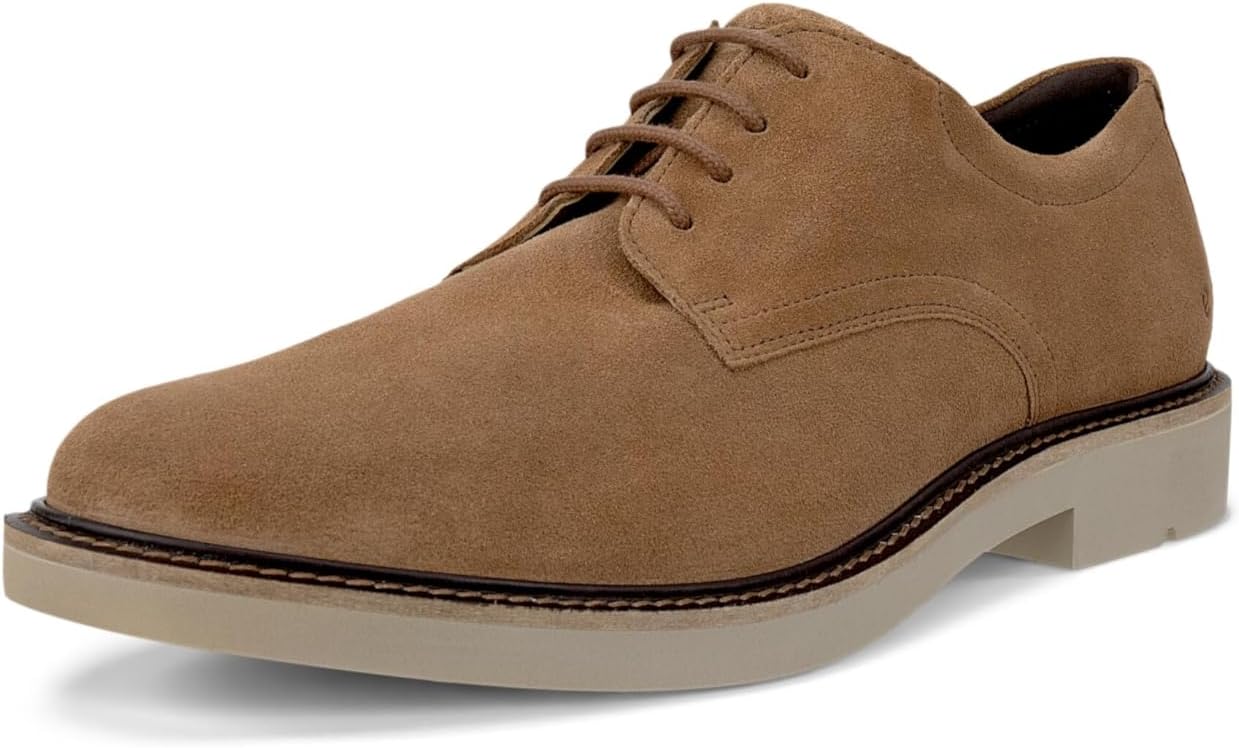
ECCO · Black
ECCO London Plain-Toe Derby
A round-toe derby profile with a removable dual-fit insole on the Amazon listing.

Rockport · Black
Rockport Margin Oxford
A practical plain-toe option for shoppers who prioritize familiar fit and subdued styling.

Bruno Marc · Black
Bruno Marc KnitFlex Breeze
A breathable hybrid that reads polished without pretending to be a formal Oxford.

Rockport · New Brown Gradient
Rockport Style Leader 2 Bike Slip-On
A Style Leader 2 slip-on loafer presented by Amazon with a bike-toe profile and comfort-oriented sole.
QUICK ANSWERS
Questions shoppers ask next.
What makes dress shoes good for standing?
A stable heel, appropriate width, correct flex point, even pressure distribution, and an outsole matched to the floor matter most. Cushioning helps only when the shoe already positions the foot correctly.
Are memory-foam dress shoes supportive?
Memory foam can reduce initial pressure, but softness alone does not provide stability or correct alignment. It may compress during a shift, so the heel platform, last shape, and outsole must also be evaluated.
Should standing shoes have removable insoles?
Removable insoles are useful for orthotics, volume adjustment, and replacement after wear, but they are not mandatory for every wearer. A fixed footbed can be comfortable when its shape and cushioning suit the foot.
How often should work dress shoes be rotated?
Alternating pairs so each receives at least a full day to dry is a practical minimum for frequent wear. Rotation can improve moisture management, reduce odor, and prevent the same pressure points from being loaded every day.